|
|
|
| Patient monitoring | |
Pressure sensor for the eye20 September 2007 A sensor developed by researchers at the Fraunhofer Institute for Microelectric Circuits and Systems IMS in Duisburg, Germany, can monitor pressure in the eye, aiding the treatment of glaucoma. It also has potential to monitor blood pressure and incontinence. If the pressure in the eye is too high, nerve fibres die, resulting in visual field loss or blindness. Since increased intraocular pressure, also known as glaucoma, is not usually painful, the condition is often diagnosed too late. Moreover, such patients often tend to develop cataracts when they get older — the lenses of their eyes become opaque. In such cases, surgeons remove the natural lens and replace it with an artificial one. To avoid further loss of nerve fibres, the intraocular pressure is then regulated as accurately as possible with the help of medication. Unfortunately, the pressure continues to vary despite medication, obligating the patient to have it constantly monitored by physicians and the medication dosage adjusted accordingly.
The top and bottom of the sensor are formed by electrodes; the top electrode is flexible, in contrast to its rigid counterpart on the bottom of the sensor. When the intraocular pressure increases, the top electrode is pushed in, reducing the distance between the top and bottom of the sensor and thus increasing the capacitance. Using a tiny antenna, the implant then sends the pressure data to a reader that is fitted into the frame of a pair of spectacles. The patient can view the results on an auxiliary device and determine whether the pressure has reached a critical level. An antenna in the spectacle frame supplies the sensor with the required energy via an electromagnetic field. “The power consumption of the sensor must be kept to an absolute minimum,” explains van den Boom. “All unused components are put in a kind of standby mode and only activated when needed.” The permanent eye implant is currently undergoing clinical trials and could come into general use in two to three years’ time. But the sensor is not only suitable for use in the eye: When implanted in blood vessels in the thigh or the upper arm it can also help patients with chronic hypertension. “Conventional devices for measuring blood pressure at home are not suitable for determining the correct medication dosage,” says van den Boom. The sensor is also expected to benefit patients suffering from increased intracranial pressure or those with incontinence problems.
|
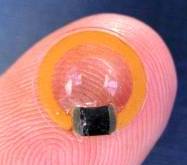 The
new sensor will obviate the need for constant visits to the physician by
such patients. “We integrate the 2.5 by 2.6mm sensor in an artificial lens,”
says Thomas van den Boom, group manager for biohybrid systems at the IMS.
“This doesn’t impair the patient’s vision.”
The
new sensor will obviate the need for constant visits to the physician by
such patients. “We integrate the 2.5 by 2.6mm sensor in an artificial lens,”
says Thomas van den Boom, group manager for biohybrid systems at the IMS.
“This doesn’t impair the patient’s vision.”